
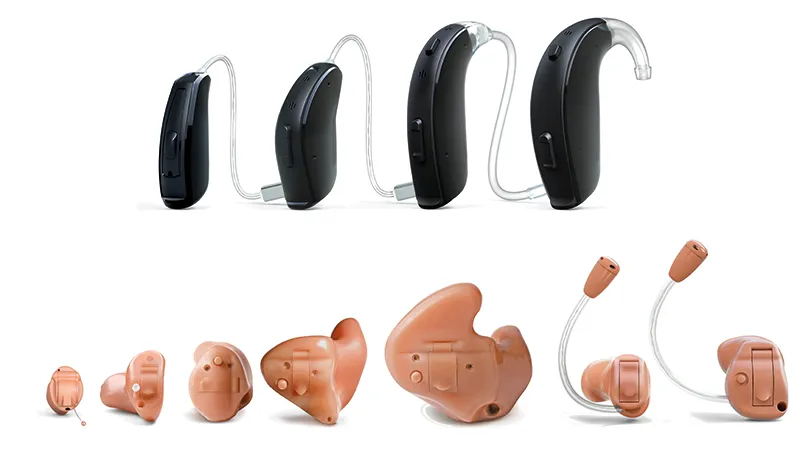
I can't begin to tell you how often I've been told by the hearing "Why don't you go to Walgreens or Bass Pro Shops and get a 'hearing amplifier'?" and "Why not just get the cheapest hearing aid you can get, surely that'll resolve your deafness right?"
First to comprehend my deafness, it's probably best to show you it by example. I was speaking with a disability advocate while writing this post and described what my hearing was like and he provided me with a YouTube video that would describe to you or show you what it's like for me in a hearing world. Give it a listen and you'll be more apt to understand my position on hearing.
It's really not all that simple. I've had hearing friends provide me with gifts of cheap hearing amplifiers, including that $20 one from Walgreens that amplifies by 30x, and honestly, the only thing it did for me was that I still couldn't understand speech at all, just made the vowels I can normally hear much louder, BUT it also made it so that I was able to hear my own footsteps for the first time in my entire life which scared the hell out of me at first. I also was able to hear a faint whir of the fridge and stove fan and when I was at Walmart, surprisingly I didn't know Wally World had music playing in the store, that was completely new to me. Granted I couldn't understand the music, but I could tell that it was there for the first time ever.
I have to say the cheapie from Walgreens actually made it much harder for me to understand speech than anything else and I still required closed captions turn on on the TV in order to be able to watch anything on it, so it wasn't really worth anything more than a few new experiences of which I simply just stopped wearing the amplifier after a few days, wasn't worth the hassle to me. The issue with the amplifier that made things harder to understand? It amplifies everything, including various background noises.
A real hearing aid developed and provided by an audiologist has filters that filter out background noise and the different hearing aid types all have different tech in them that are based around an individual's hearing needs. There's a huge base of sound that I simply cannot hear as evidenced by the fact that I can't catch consonants in speech and there are a few vowel sounds that I also regularly miss in men who have deeper voices, then you get to women and children, I can't hear that what-so-ever except that one old lady everyone talks about because she has a long history of chain smoking and sounds like a raspy dude that worked in the coal mines.
Some hearing aids add extra frequencies while others fold the frequences down, not sure how to best explain that one. It's like you take a high pitched frequency. It's easier to explain in example, especially in relation to understanding what it's like for the Hard of Hearing, just take in mind that with my deafness, my comprehension of speech is far more profound to where the example in an unfair hearing test YT Video doesn't help me at all with the added frequencies. The video I linked to the Unfair Hearing Test should, I hope, give you the understanding of why simply "Amplifying" the audio doesn't entirely work. For example I amplify my system audio upwards to 1200%, as high as I can go without destroying my headphones, and I can just barely make out some music, but it also helps a small bit with speech as it does allow me to somewhat get some consonants I'd normally miss otherwise.
The hearing aids are important and it's worth noting that hearing aids and hearing amplifiers are two entirely different animals with different technology inside them. Hearing aids of today compared to back when I was younger with my old analog hearing aids have digital channels, more filtering, more frequencies and have FM and Bluetooth compatibility and the like resulting in better usage of technology like cell phones, bluetooth enabled devices in general and as well as other misc but still lovely benefits that normal hearing individuals take for granted.
There's a whole field of science that goes into the study, development, engineering and study of the hearing, hearing loss, deafness and ways to correct bad hearing and that technology is rapidly improving in the realm of hearing aids and even cochlear implants have gotten better over the ages going from the deaf hearing distorted robotic voices to near perfect representation of what's said accordingly to the voice of the individual speaking.
I'm currently underway of getting my hearing corrected and I'll be updating you guys on Steemit either by these blog posts or via video on d.Tube about my progress. So far I got the medicaid application I needed filled out and mailed out. It took 3 tries to get it, and I had to go to the office itself, only to get told "Oh, that's in the next building over" so I go to the next building and get told "Well I can print the application for you, but we don't handle that at this office" so I got the application and went to the post office for an envelope at least so I got the correct one this time.
I was using a live caption app on my Android device the first time I asked for the application to be mailed to me, detailing that I needed the application for the Medicare QMB program for the disabled. I got sent the women for women and children. Figured OK, maybe I didn't speak correctly, so I got a relay service to make the call for me, got an old dude because old guys are better at handling those cubicle warriors instead of getting instantly hung up on which happens far too often for the deaf's relay services (they think we're telemarketers) and had him also get me the application in the mail that I needed. I was signing back and forth with him while he spoke over the phone to the office rep. Office rep sent yet again the application for women and children. The issue? The woman and children application can be done online, but the one I needed, it's linked to on their website but it goes to a 404. It was like pulling teeth. Being deaf and being unable to drive doesn't help in these matters so I had to wait for my room mate to have a day off work on a weekday to get the damn application.
I finally got the right one and got it because I was in person. Luckily I had a hearing friend with me who helped me get what I needed because I was having constant, non stop issues at the office just trying to get the application I needed. I informed them on the sign in sheet "I'm deaf" so what do they do? Call my name over the intercom.
BZZT "Will the deaf guy that can't hear this message please come to window B4? The deaf guy that can't hear this message to window B4, thank you."
I know, how about next time I need a driver for a DVD Drive on my computer the company sends me a DVD with the driver on it? Or old tech, a driver needed for an external floppy disk drive and the drive comes on a floppy?
The issue is that my hearing friend was out in the car waiting for 30 minutes while I awaited to be called, and I was called, I just didn't hear it for obvious reasons of being deaf, I didn't know they had an intercom system that was working, could've been broken for all I knew if I didn't see people just randomly get up every so often and go to a window, I'd have believed it to be broken or there was some sort of telepathic thing that I was merely immune to which is what it's like for me.
So I go back up with my hearing friend, he asks if my name has been called and the chick at the front says "Yeah he was called 20 minutes ago, if he's still here he needs to sign in again" and then he asked if they went in to visually notify me because I'm deaf and if they even noticed the note I put on the sign in sheet of "I'm deaf". They said "Yes, we saw the note and he was called over the intercom" to which my friend asked "How is the deaf meant to hear over the intercom when they can't hear?"
A manager ended up having to get involved and it was the manager that ended up printing the application I needed.
That's the story of my hell in trying to get the insurance I need to correct my hearing. I'll be seeing an audiologist likely the start of March somewhere and the hearing specialist will determine if I could benefit from hearing aids or if I need a cochlear implant.