
Peter Paul Rubens, uno de los más importantes pintores del Barroco europeo, específicamente en la pintura flamenca, nació el 28 de junio de 1577. La sensualidad y exuberancia de su obra —propias del barroco—, pero tocada por la influencia de la antigüedad clásica y renacentista, se hizo presente en la mayoría de sus pinturas. Una de ellas, quizás la más famosa o conocida, es Las Tres Gracias, a partir de la cual invento esta ficción breve, imaginando una posible deriva psíquica —desdoblada–del artista, o una perspectiva exterior de testigo casi omnisciente.
Peter Paul Rubens, one of the most important painters of the European Baroque, specifically in Flemish painting, was born on June 28, 11577. The sensuality and exuberance of his work, but touched by the influence of classical antiquity and Renaissance, was present in most of his paintings. One of them, perhaps the most famous or known, is The Three Graces, from which I invent this short fiction imagining a possible psychic drift -unfolded- of the artist, or an external perspective as an almost omniscient witness.
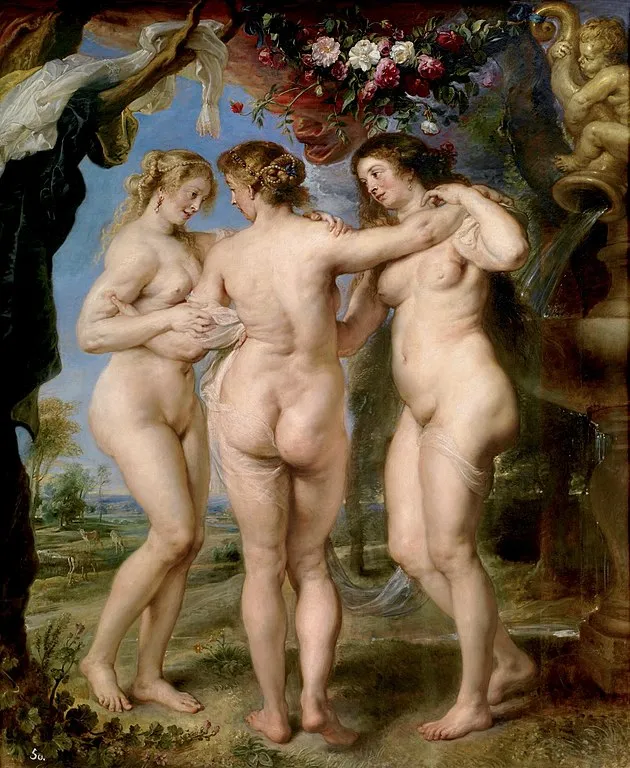
Se regodeaba en su placer visual. No había duda. Recorrer aquellos cuerpos fuertes y blandos a la vez; casi tocar sus redondeces; palpar imaginariamente sus protuberantes pubis, las curvas de sus espaldas, para bajar y solazarse en sus torneados traseros. Sentía en sus manos, o en sus ojos, la delicadeza transparente de las gazas que entregaban sus desnudeces al aire libre de aquel campo iluminado por la gracia de la naturaleza.
Las tres deidades en sus divinos cuerpos alegraban hoy más que nunca su vida ya muy madura. ¿Estaba ahí Isabella Brant y Helena Fourment, su primera y su segunda esposa, con sus juveniles carnes gozosas y pudorosas al mismo tiempo? ¿Y la tercera? ¿Acaso la mujer que vivía en el deseo que permanece en su imaginación, la que no pudo ser?
No podía dejar de contemplarlas pintadas sobre la inmensa madera de roble que había adquirido para darse ese gusto profano. Sabía que su catolicismo nunca lo apartaría de deleitarse en el fino amor por las míticas estampas de su visión humana, sabiéndola efímera como el propio placer. Solo en la finitud y el contraste podría vivir la trascendencia, como estos tiempos del arte lo mostraban.
Contemplaba entusiasta y pícaro, como un fauno curioso, o como ese pequeño cupido, que derrama sus aguas abundantes por la cornucopia apegada a su cuerpo, la fuente de la vida, y salpica con sus escapadas gotas a la belleza sensual de la gracia divina.
He basked in his visual pleasure. There was no doubt about it. To walk around those strong and soft bodies at the same time; to almost touch their roundness; to imaginatively feel their bulging pubes, the curves of their backs, to go down and take pleasure in their shapely buttocks. He felt in his hands, or in his eyes, the transparent delicacy of the gauzes that surrendered their nakedness to the open air of that field illuminated by the grace of nature.
The three deities in their divine bodies cheered his already mature life more than ever. Was there Isabella Brant and Helena Fourment, his first and his second wife, with their youthful, joyful and modest flesh at the same time? And the third, the woman who lived in the desire that remains in his imagination, the one who could not be?
He could not stop contemplating them painted on the immense oak wood he had acquired to indulge in this profane pleasure. He knew that his Catholicism would never keep him from delighting in the fine love for the mythical prints of his human vision, knowing it to be as ephemeral as pleasure itself. Only in finiteness and contrast could he live transcendence, as these times of art showed him.
He contemplated enthusiastically and mischievously, like a curious faun, or like that little cupid, who pours his abundant waters through the cornucopia attached to his body, the source of life, and splashes with his escaped drops the sensual beauty of divine grace.

Gracias por su lectura | Thank you for reading.
 ?
?