
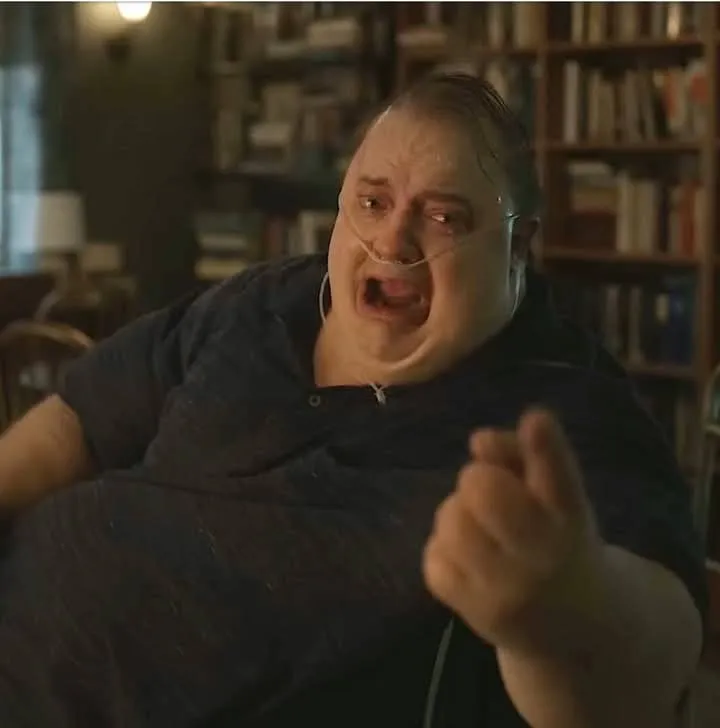
La autodestrucción es ese fenómeno basado en la destrucción de sí mismo, ya sea mediante una autoinmolación que sacrifique tu cuerpo y tu alma o una vía de aniquilamiento propio que termine con el fin de este individuo, o sea, de uno mismo.
Después de ver la película "The whale" / "La ballena", he comprendido el poder autodestructivo del amor, rectifico: siempre lo supe, pero nunca lo vi desde una perspectiva diferente, es decir, un ser humano abandonarse a sí mismo varias veces, proporcionarse una muerte lenta porque el amor hacia los demás es superior al de sí mismo sin llegar a autocompadecerse.
He tratado de comprenderlo desde una óptica que me haga olvidar su baja autoestima, porque es cierto que este es uno de los primeros factores. La autoestima funciona como una inmunidad, te permite luchar contra ciertas cosas que te pasan a lo largo de tu vida y de esta manera esas cosas te afectan menos o quizás ni lleguen a modificar tu manera de afrontar la vida.
Voy a olvidar que Charlie era un hombre psicológicamente vulnerable. Me voy a centrar en la capacidad de amar sin límites, esto, unido a una depresión, le provocaba una ceguera interna.
Yo nunca vi un monstruo en Brendan Fraser, solo vi a un hombre de emociones autolesionándose con ingerir alimentos descontrolada mente, un hombre que amó más allá de la pérdida física de esa persona, un hombre que intentaba retomar una paternidad perdida, un hombre que no quería hacerle daño a su cuidadora, un hombre que quería enseñarle a sus alumnos cómo ser sincero en cada palabra de sus redacciones, un hombre que poseía la capacidad de amar más allá de cualquier límite existente... ¿Cómo puede alguien así ser un monstruo?

¿Un hombre que ama tanto a los demás, cómo puede no amarse a sí mismo? Es esto lo que me preocupa, su abandono personal sin intento de salvarse (en este caso comer en exceso y empeorar su obesidad mórbida hasta el punto que fue dañino para su salud). Pero Charlie no era un monstruo, no era desagradable más allá de la apariencia que nos mostraba, Charlie amaba, amaba como pocas personas aman y no pretendo justificar la autodestrucción del ser humano por causa del amor, pero toda persona en el mundo tiene derecho a amar desmedidamente, sin confundirlo con una obsesión u otra enfermedad mental.
Charlie siempre supo las consecuencias, estaba consciente de que practicaba una especie de suicidio gradual, pero él, aún así, conservaba la capacidad de amar a otros...Charlie no fue un monstruo a mis ojos, no, creo que este personaje nos muestra a alguien que sacrificó su cuerpo y hasta su espíritu llevándolo a un cuestionamiento de su existencia misma.
¿Amar con toda nuestra fuerza podría salvarnos o condenarnos?
Self-destruction is that phenomenon rooted in the annihilation of oneself—whether through an immolation that sacrifices body and soul, or a path of self-annihilation that ends with the erasure of the individual, that is, of one’s own being.
After watching The Whale, I’ve come to understand the self-destructive power of love. No—correction: I’ve always known it, but I’d never seen it from this perspective: a human being surrendering themselves, over and over, submitting to a slow death because their love for others outweighs love for themselves—yet without sinking into self-pity.
I’ve tried to analyze it through a lens that ignores his low self-esteem, though it’s undeniable that this was a key factor. Self-esteem acts as immunity; it lets you fight against the things that happen to you in life, so they affect you less—or perhaps don’t even alter your way of facing existence.
I’ll forget that Charlie was a psychologically vulnerable man. Instead, I’ll focus on his capacity for boundless love—which, combined with depression, created an internal blindness.
I never saw a monster in Brendan Fraser. I saw only a man of raw emotion, self-harming through uncontrolled eating, a man who loved beyond the physical loss of that person, a man trying to reclaim a lost fatherhood, a man who refused to hurt his caretaker, a man who wanted to teach his students honesty in every word they wrote, a man with the ability to love beyond any conceivable limit... How could someone like that be a monster?

How can a man who loves others so deeply fail to love himself?This is what troubles me—his self-abandonment, his lack of effort to save himself (in this case, overeating to the point of worsening his morbid obesity until it destroyed his health). But Charlie wasn’t a monster. He wasn’t unkind, beyond the appearance he showed the world. Charlie loved—he loved in a way few people do. And I’m not trying to justify human self-destruction in the name of love, but every person in this world has the right to love excessively—so long as it isn’t confused with obsession or another mental illness.
Charlie always knew the consequences. He was aware he was enacting a kind of gradual suicide. Yet even then, he retained the capacity to love others... To me, Charlie was no monster. No—this character shows us someone who sacrificed his body, even his spirit, pushing himself to question his very existence.
Could loving with all our strength save us—or condemn us?
Este post es original y las imágenes son tomadas de la red/This is an original post, and the images are from the internet.

Este Banner fue creado por la usuaria @yuraimatc/ This Banner was created by user @yuraimatc
Mi nombre es Liliana Isabel Salazar Villariño, tengo 30 años y vivo en La Habana, Cuba. Soy graduada de Médico General, también soy escritora y promotora cultural//My name is Liliana Isabel Salazar Villariño, I am 30 years old, and I live in Havana, Cuba. I am a graduate in General Medicine, and I am also a writer and cultural promoter.