The Kantjiu Temple is one of the few ancient monuments in Bangladesh that is famous for its time. Kaharol Upazila Sadar is several kilometers north of Dinajpur city. Sundarpur Union is located seven to eight kilometers south-east of Sadar. This temple is still standing on the Dinajpur-Tentulia highway near the Dhepa river. The temple was built to house the idols of Lord Krishna.
Although this temple is in Shyamgarh area, it is because of this temple that this place is renamed as Kantnagar. That is why many people call this temple the temple of Kantnagar. Again, the temple built for Lord Krishna is also called Kantjiu or Kantji's temple in that sense. This three-storied temple had nine pinnacles or gems, as the architectural style of this temple was in the Navaratna style of architecture. That is why it is also called Navaratna temple.
image soruce
To the north of the temple is the inscription of the foundation. Renowned archaeologist Abul Kalam Mohammad Zakaria translated the inscription, which states:
King Prannath started the construction of the magnificent palace-like Navaratna temple. In 184 Shake (1852 AD), King Ramnath dedicated this temple to Kant (Srikrishna) at Kant's hometown (Kantnagar) for the fulfillment of his father's resolve to please Rukminikant (Krishna).
According to the script of the foundation and reviewing the history, the foundation stone of this temple was laid in 1804 by Maharaja Prannath Roy, the eminent zamindar of Dinajpur. In the last days of his life, Maharaja Prannath Roy entrusted the task of completing the unfinished work of the temple to his adopted son, Maharaja Ramnath Roy. Maharaja Ramnath Roy resumed work on the temple in 1822. Work on the main temple was completed in 1852.
[image soruce] (https://www.google.com/search?q=kantojir+mondir+pic&rlz=1C1CHBD_enBD772BD773&sxsrf=ALeKk01Iko-vl5-SUwabJl28uzP-W-whEw:1618215628373&source=lnms&tbm=isch&sa=X&ved=2ahUKEwi1rcv9ovjvAhVHH7cAHdRMDm4Q_AUoAXoECAEQAw&biw=1707&bih=781#imgrc=c6mTkny_2TlEvM)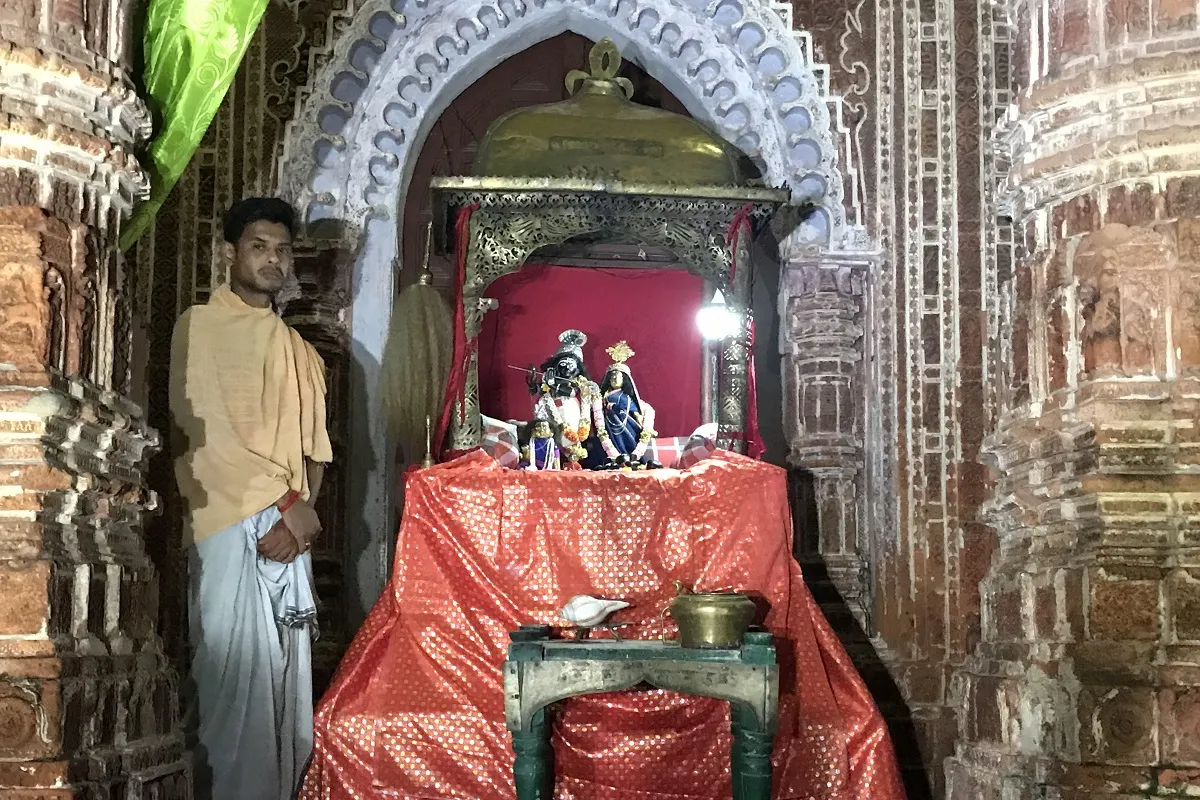
There are different views on the construction materials of this temple. The temple was built with building materials from the ruins of a huge wall at a place called Bannagar near Gangarampur (now Dinajpur). It is also known that the stones used for the construction of this temple were brought from the Himalayas, the Raj Mahal hills of Bihar and the hills of Assam. However, there is no doubt that the construction of this temple was a combination of solid stone as well as brick, sand and terracotta.
image soruce 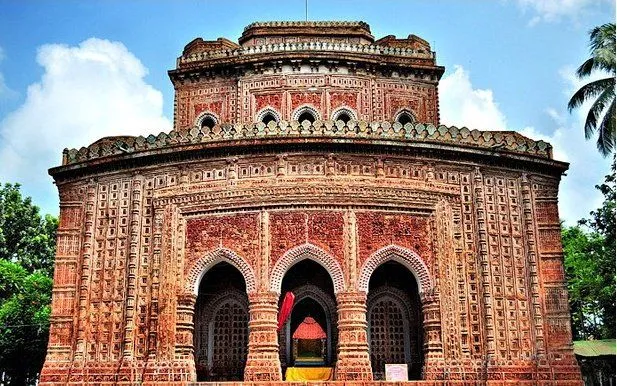
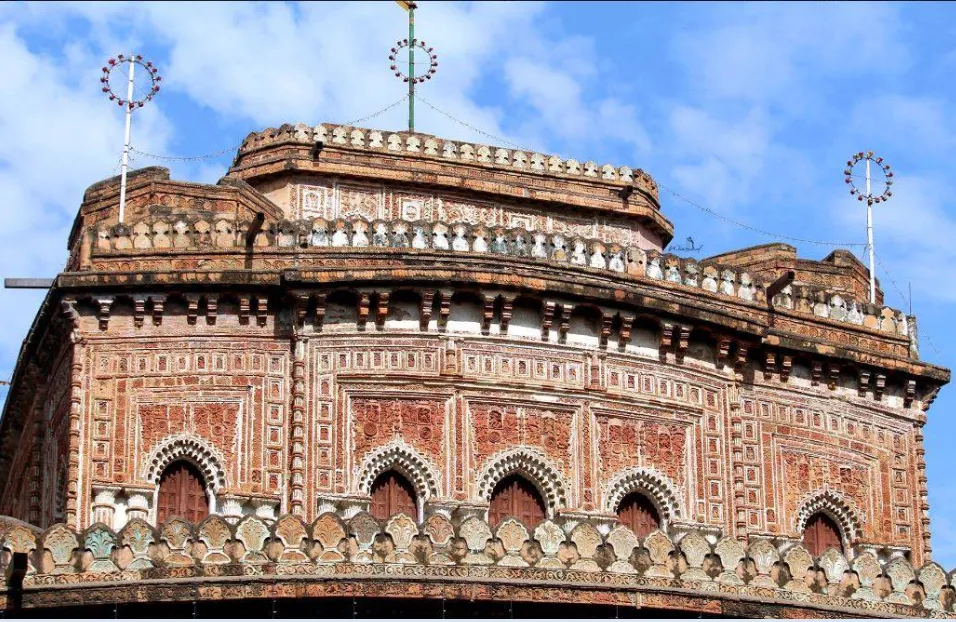
The temple is situated on a square altar with arms about 18 meters high and 1 meter high. The length of each arm of the temple is 18 meters, which is made entirely of brick. Although the courtyard of the temple looks rectangular in shape, this three-storied building standing on a stone altar is a square building 50 feet high. The three-storied temple is pyramid-shaped with three steps rising to the top, and each step uses a pinnacle or gem. In the first and second steps there are four and eight peaks and in the highest stage there is a separate peak with nine peaks or gems or Navaratna.
The reason for the design of the temple in this way is that looking at the temple from a distance, it seems that a chariot decorated on a high altar is ready to embark. In addition, an open archway has been placed around the main temple standing on the altar. In this way, all the worshipers who come to worship can see the idol kept in the holy place inside. On the ground floor of the main temple, in the inner room called Garbhagriha, there is an idol of Lord Krishna.
[image soruce] (https://www.google.com/search?q=kantojir+mondir+pic&rlz=1C1CHBD_enBD772BD773&sxsrf=ALeKk01Iko-vl5-SUwabJl28uzP-W-whEw:1618215628373&source=lnms&tbm=isch&sa=X&ved=2ahUKEwi1rcv9ovjvAhVHH7cAHdRMDm4Q_AUoAXoECAEQAw&biw=1707&bih=781#imgrc=c6mTkny_2TlEvM) 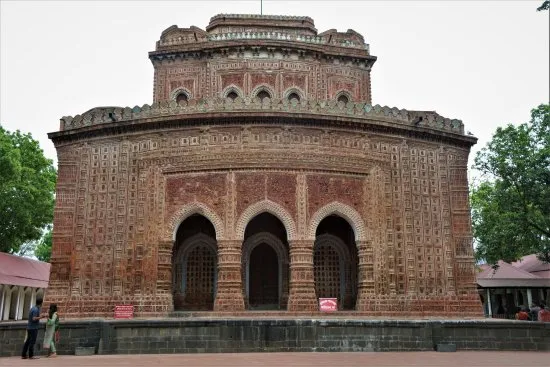
Initially, the temple was about 60 feet high and had nine peaks, but now it stands at 50 feet high with three floors without peaks. This is because of The Great Indian Earthquake, which struck on June 12, 1896. The 6.7 magnitude earthquake destroyed thousands of homes in Burma, India, Bhutan and Bengal. Nine peaks of the Kantjiu Temple collapsed in the quake. Later, Maharaja Girijanath Bahadur tried hard but was not able to restore the temple to its former appearance. As a result, he rebuilt the three-storeyed temple with nine exceptions.
The temple has four rectangular verandas around the prayer room. Each of the entrances on the ground floor has ornate arches rich in ornaments. The arches are separated by two brick pillars, which are rich in eye-catching ornaments. On the ground floor there are a total of 21 arched doors outside the four cells, on the second floor there are 26; But since the third floor is getting smaller, there are only 3 doors.
On the second verandah on the west side of the temple, there is a dark narrow but wide staircase, which has been climbed up and down the third floor. The curved cornice of the ground floor roof hangs at right angles. The two-story carved octagonal towers carry the weight of each of the separate cells on the ground floor. The main structure stands proudly as it strengthens the foundation with separate cells.
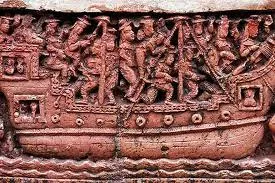
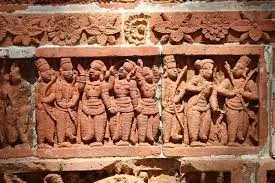
Just as the beauty of the ornate chariot can be seen from a distance in the Kantjiu temple, the fascination with terracotta terracotta grows even closer when approached. There are about 15,000 or more terracottas throughout the temple. There is not as much variety of content in terracotta as there is in other ancient monuments of Bangladesh or such a huge amount of terracotta. These terracotta terracotta temples in every inch of the temple tell the story of the development of the beauty as well as the three myths.
[image soruce] (https://www.google.com/search?q=kantojir+mondir+pic&rlz=1C1CHBD_enBD772BD773&sxsrf=ALeKk01Iko-vl5-SUwabJl28uzP-W-whEw:1618215628373&source=lnms&tbm=isch&sa=X&ved=2ahUKEwi1rcv9ovjvAhVHH7cAHdRMDm4Q_AUoAXoECAEQAw&biw=1707&bih=781#imgrc=c6mTkny_2TlEvM) 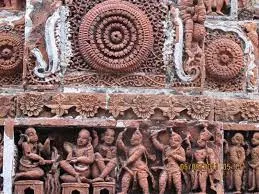
These terracotta plaques are decorated with anecdotes of Ramayana, Mahabharata and Sri Krishna. The four walls of the temple tell the history of four different classical eras in these terracotta. The ages are- Satya, Treta, Dwapar and Kali. Not just mythology, but the activities of the Mughal emperors, or the social life of the time
[image soruce]