
Back in the fall, I posted about collecting seeds from the trees I encountered while I was in the city for work. Through my travels, I collected acorns, apple seeds, and Ohio Buckeye nuts.
At first, I just had them sitting on the kitchen counter in paper coffee cups but I knew this wasn't a good long-term solution, especially if I wanted them to survive over winter. After a little research, I learned that acorns needed to be kept damp and chilled to maintain their viability.
 Ohio Buckeye seeds coated with fungus.
Unfortunately, the same damp and chilly conditions that they stored well at also provided the stratification they needed to germinate. Most of the articles I read on propagating oaks from acorns said about 60 days at 40°F was sufficient for stratification.
The information on storing Buckeye's was a little harder to find and I didn't come across many good articles regarding proper storage. One thing that was clear though, was that they also needed to be kept moist.
Since my life has been super hectic for many months now, storing acorns and buckeyes was put off for quite awhile and then, when I finally got around to it, I just rushed through the process. Normally, it isn't in my nature to rush projects, I like to research, think, and then formulate a plan. In this case though, I just had to do it on the fly otherwise it just wouldn't get done.
 Several of the Buckeyes have sprouted already and I have no idea what to do with them.
The articles I read suggested using damp sand or sawdust to store the acorns, probably because these are relatively sterile substrates and there is less of a chance for molds and funguses to infect your seeds. All I had lying around though was peat moss. I found some small containers, filled them with peat moss, and put both the acorns and buckeyes in them. They had lids so I either poked small holes in them or left them slightly ajar.
A few weeks ago I checked the containers and everything seemed fine. By stirring them up, however, I brought the seeds to the surface and I was worried that they might dry out too much. Pushing them down was difficult to do without putting excessive pressure on the other seeds below. I didn't have any peat at this time but I did have some potting mix which is mostly peat so I figured using it as a top layer over the seeds would be fine.
 The acorns seem fine. No signs of fungus.
Well, I checked on the buckeyes again last night and I encountered a large rubbery mass surrounding about half of them. At first, I thought it was mold and I was super worried that my substrate was too wet and I had killed all of my seeds. After closer inspection, however, it appeared that the white stuff was some sort of fungus.
That is when it dawned on me that this potting mix had mycorrhizae in it! I had unintentionally inoculated my seeds with some sort of fungus. At this point I decided to empty all my containers to see what was going on. I had no idea whether or not I had ruined my buckeyes. I was also concerned about the state of my acorns as well.
After emptying the containers, I was relieved to find that only the buckeyes had the mycorrhizae on them. I was able to peel it off and most of the buckeyes seem to have remained intact underneath so I am unsure what exactly the fungus is feeding on. Could the buckeyes be releasing some sort of exudate that it is feeding on?
 About half the buckeyes seemed unaffected by the fungus.
I also discovered that three of the buckeyes had sprouted. The good news is, I know that at least some of them are viable but the bad news is our winter is super long and spring won't be here for a few more months. I am really not sure what to do with them.
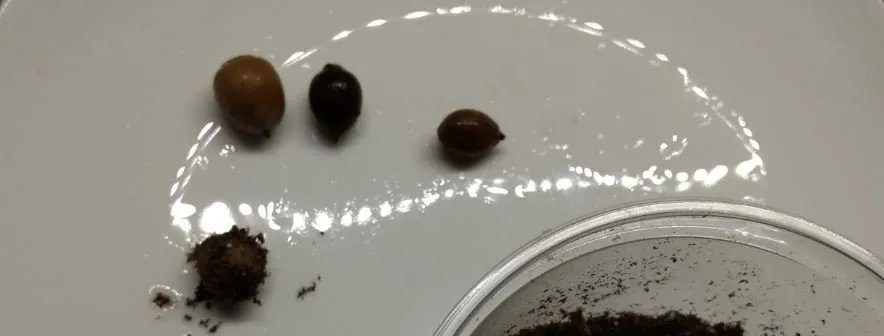
I rinsed off the buckeyes that didn't seem to be affected by the fungus to make sure they were alright and they still looked about the same as when I put them in the containers. I also rinsed a few of the acorns off and they looked fine also. None of the acorns have sprouted yet.
I decided to put the buckeyes with the fungus back into the original container. I am curious to see if they still germinate even though they are covered in a rubbery layer. I put the rinsed buckeyes into a new container, hopefully they aren't contaminated. The acorns I just put back in the original containers because they seemed fine.
Now the question is what do I do with the sprouted buckeyes? Do I plant them now and try to coddle them inside until I can put them out in the spring? Do you think I have ruined the other seeds?
If you have any comments or suggestions I am all ears! I just hope that I can get a handful of Ohio Buckeyes and Oaks out of this mess.
 I also rinsed off a few acorns and they seem fine, as far as I can tell.
Sources:
https://dnr.wi.gov/education/documents/StepbyStep.pdf0176
http://www.uky.edu/hort/propagation-ohio-buckeye