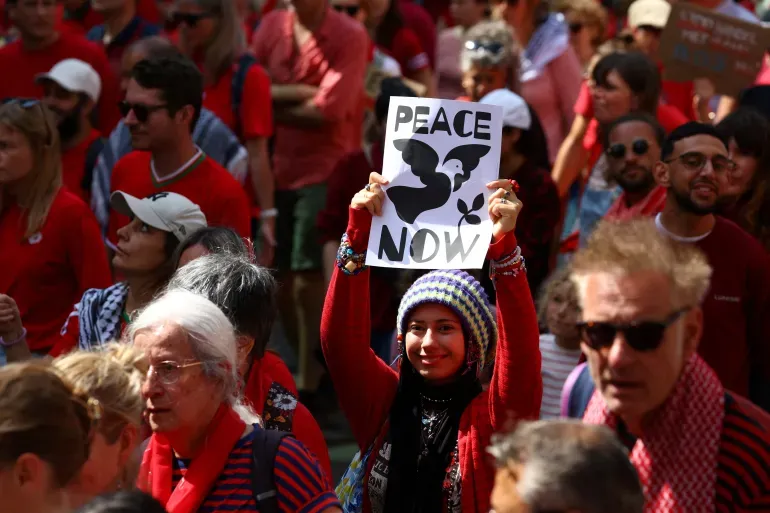
In a historic scene reflecting the depth of public and humanitarian outrage, tens of thousands of demonstrators gathered last Sunday in The Hague, Netherlands, in one of the largest pro-Palestinian marches since the war on Gaza began over twenty months ago. Organizers estimated the crowd at over 150,000 people, including families and children, many of whom dressed in red as a symbolic gesture representing a "red line" they accuse the Dutch government of failing to draw in the face of what they describe as genocide committed by Israel against Palestinians in Gaza.
The march headed toward the International Court of Justice, which is currently hearing a case brought by South Africa accusing Israel of committing genocide. Protesters carried signs, sang, and gave speeches calling for clear and effective sanctions on Israel, while criticizing the Dutch government for avoiding direct condemnation or meaningful action despite overwhelming evidence and mounting casualties.
Amid this atmosphere, Dutch caretaker Prime Minister Dick Schoof stated that the voices of the people were being heard and acknowledged the deep frustration and anger, affirming that the government’s goal is “to end the suffering in Gaza as soon as possible.” Protesters, however, dismissed these statements as insufficient, given the ongoing bombardment and worsening humanitarian crisis.
From a humanitarian perspective, the situation in Gaza has reached catastrophic levels. More than 55,000 Palestinians have been killed—most of them civilians—and around 118,000 have been injured. Nearly half a million people are at risk of famine due to the blockade and the near-total absence of humanitarian aid. Ninety percent of the population has been displaced, and the healthcare system is on the verge of collapse, with no medical supplies allowed in for more than eleven weeks. People are living in constant fear, struggling daily for food, water, and safety, while families with missing or captive loved ones remain trapped between hope and despair.
Despite pressure from the public, civil society, and major human rights organizations such as Oxfam and Amnesty International, the Dutch government remains hesitant to take a firm stance against Israel. The caretaker foreign minister had previously called on the European Union to review its cooperation with Israel, but no significant action or official position has followed.
In this grim context, popular protests—such as the one in The Hague—remain a powerful expression of human conscience and a voice for the voiceless. As the airstrikes continue, people around the world cling more tightly to the values of justice and humanity, urging their leaders to act and bring an end to the suffering, rather than standing by in silence.