
Amongst politics, sports or whether to use windows or apple, I believe it is safe to put nuclear energy into the list of most debated topics. Already since the discovery of practical uses for nuclear fission, the energy source has been related to the destructive forces of atomic weapons or nuclear meltdowns resulting in entire regions made inaccessible and radioactive materials possibly leaking into nature such as happened in Chernobyl or Fukushima. But why on earth does it still makes up 10% of our global energy production? If you give me a moment of your time I will try to explain to you why nuclear energy is not that bad and why it might be better if it made up even more of the global energy production.
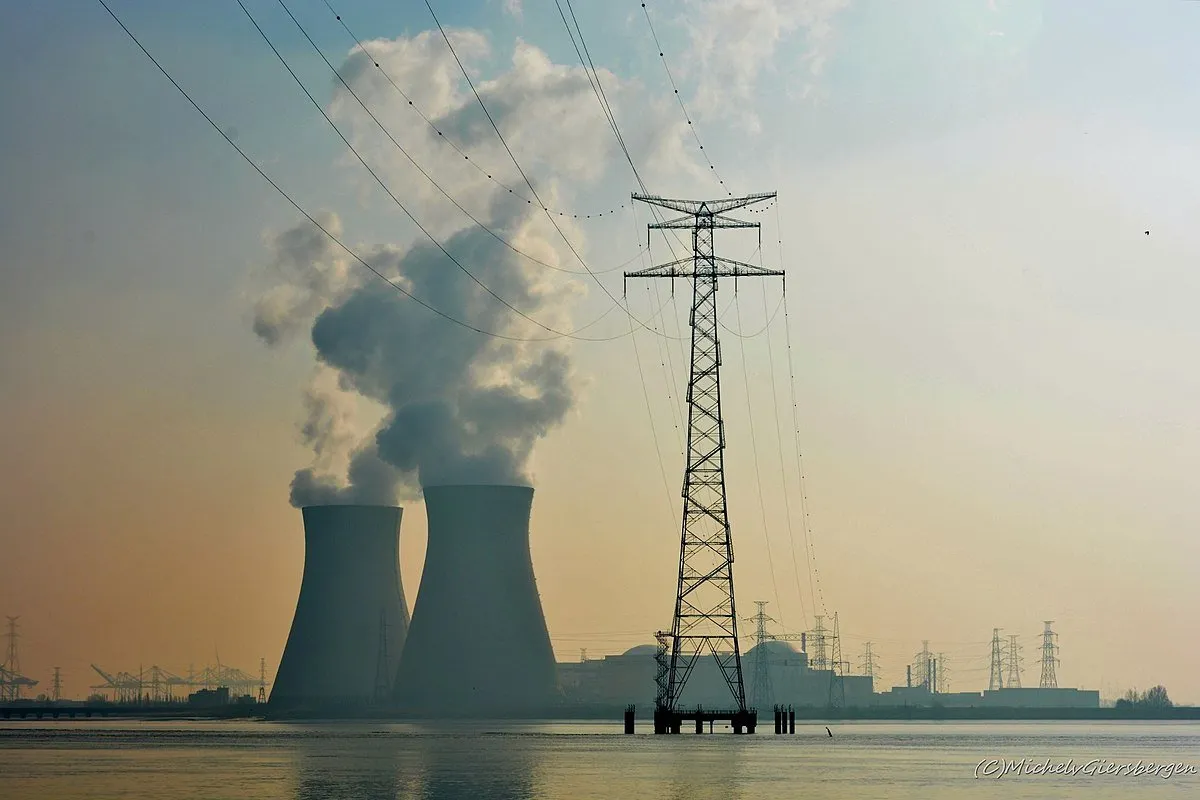
Nuclear power plant located in Antwerp, one of the biggest Belgian cities. Shared under CC BY-SA 4.0 by Michel van Giersbergen. fyi: The towers are not the nuclear power plant. These only serve to cool the plant via condensation of water. Similar towers can also be seen on plants that burn fossil fuels for example. The actual reactor is more often a dome on the site, or even under ground.
Common misconceptions
Nuclear technology is dangerous
To put it shortly, almost all nuclear power plants use outdated technology. The weighted average age of all operating reactors was 29 in 2015 and still increasing. Meaning more and more are becoming out dated than new reactors are being built. over half of all plants have worked for more than 30 years and 54 have run over 40 years. To put that into perspective, more than 50% were already active when the internet was developed and portable CD players became a thing.
Of course plants can be renovated and they are eventually designed to last that long (common lifetime prediction of 40 years with possible extensions), but this does not take away the fact that in the meantime new core technologies have been developed. And if all plants would actually close after the proposed lifetime of 40 years, 188 new units would have to be replaced by 2030. Currently 60 new reactors are in the process of being built of which 75% are delayed. Furthermore almost half of these are built in China. If we even want to sustain the same power production we have to achieve five times the number of new startups achieved in last decade, or used dated technology.
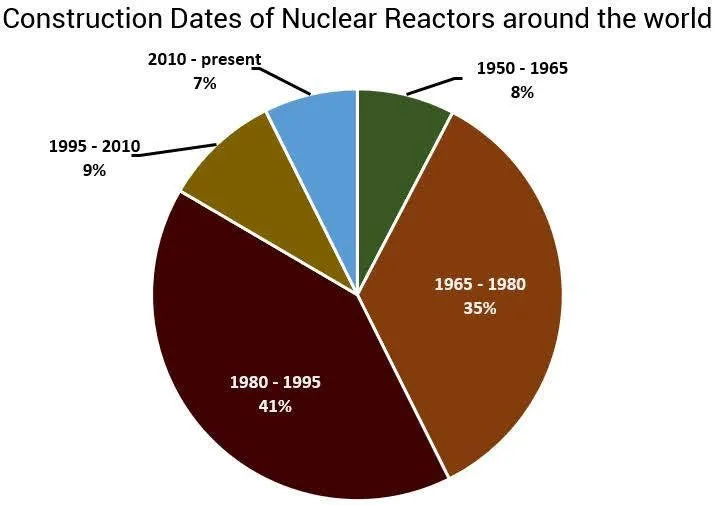
Graph illustrating construction time of reactors in the world. Almost all reactors are constructed between 1965 and 1995. In the last 10 years almost no new reactors have been finished and there are almost more plants being decommissioned than that are being built. Data from Schneider, Frogatt, Hazemann, Tadahiro, &; Thomas (2015).
So the perception that people have about nuclear power plants is actually a perception of how they were 30 years ago. If you want see what new technology looks like, I can direct you to this page by "world-nuclear.org/..." with a lot of text and facts, or this wikipedia page. These are not only more efficient and have a longer lifetime, but also a lot safer.
Nuclear waste is a hazard to the environment
Most of the waste is easily disposable and recyclable. Even the high radioactive waste can be reduced by about 85% when it is recycled into fresh fuel. If you would combine all leftover high level radioactive waste ever produced you would fill a soccer field up to about 3 meters (IAEA estimates, 2018).
And to put nuclear waste into a context, you have to consider the byproducts of other large-scale commercial electricity producing technologies. Fossil fuels supplied in 2016 67% of our energy demand, releasing approximately 15 Gigatonnes (Gt) of CO2 into the atmosphere. Nuclear power on the other hand would only produce 2% of that, cutting global CO2 emissions almost in half (in 2017 32.5 Gt were emitted according to OECD/IEA, 2018).
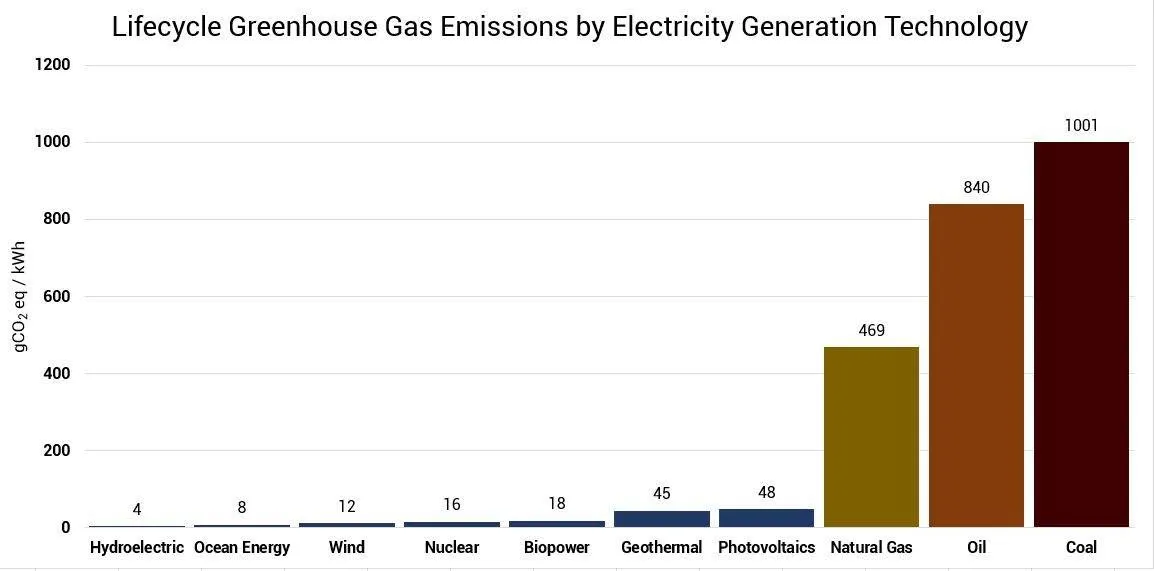
Mean equivalent of CO2 emission per kWh for different energy sources. Note that nuclear energy by mean ranks even better than Photovoltaics, biopower and geothermal energy. Data from the IPCC's special report on renewable energy sources and climate change mitigation (SRREN). If you want more information about this data I suggest you visit the report.
In over 50 years of nuclear power generation and waste management not a single case is recorded of any serious health or environmental problems or risks. Working at nuclear plants is also considered as one of the safest industrial working environments in the US according to the Nuclear Energy Institute (NEI).
And as a last addition I want to add that nuclear reactors are not the only industry creating radioactive waste. Radioactive material produced in the oil and gas industry might be called 'Technologically Enhanced Naturally Ocurring Radiactive Materials' (TENORM), but it still has almost 1000 times more radiation than allowed for recycling.
Failure of nuclear power plants can cause explosion or natural disaster
First of all, nuclear reactors cannot explode like an atomic bomb. Natural uranium contains about 0.7% of the usable U-235 isotope, the remaining 99.3% is U-238. Nuclear reactors commonly require enrichment up to 3-5% of U-235 while an atomic bomb requires an enrichment to about 85%. (although 20% enriched uranium could be weaponized, it would require a critical mass of hundreds of kilograms of the material which is impractical and rarely achieved in nuclear reactors. Therefor it is impossible for a nuclear reactor to explode as an atomic bomb.
Three Mile Island, Chernobyl and Fukushima
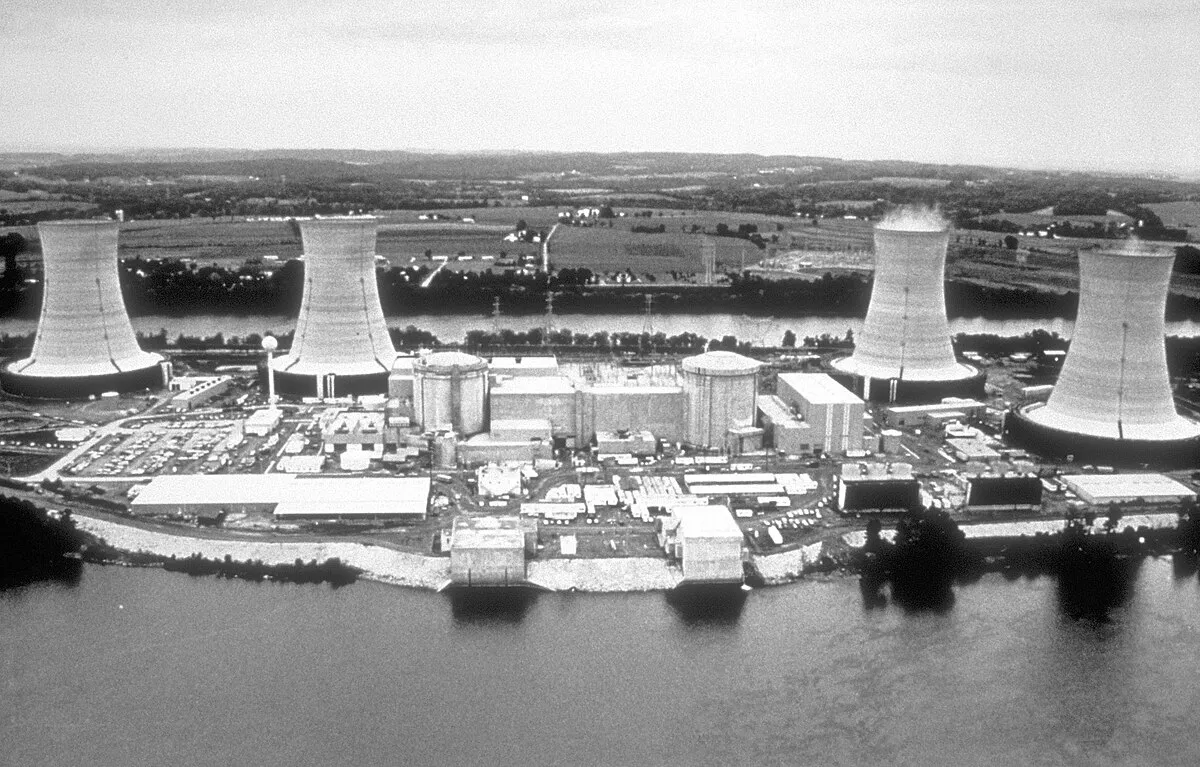 Three Mile Island nuclear power plant. Image in public domain.
There have been three major reactor accidents in the history of civil nuclear energy. First there was Three Mile Island in 1979. The cooling system malfunctioned and caused a part of the core to melt. during shutdown a valve that should have been closed stayed open. There was no sensor to directly detect the valves position so this was only restored later while some radioactive gas was already released in the atmosphere. But the dose was not enough to cause significant danger to the surrounding.
Secondly we have the Chernobyl accident in Ukraine, 1986. A flawed reactor design was operated by inadequately trained personnel and caused a steam explosion. 5% of the radioactive core was released into the atmosphere during the fire. The rest of the story is probably familiar to most readers, 30 operators and fireman died within the following months due to radiation poisoning of the first day, and many rescue workers were exposed to high doses of radiation. Now there seems to be no major public health impact after 14 years of radiation exposure and it is officially a tourist attraction. This type of reactor has never been built outside of the former Soviet Union.
And lastly the Fukushima incident. A tsunami in 2011 hit the cooling systems of three Japanese reactors. radioactive cooling liquids were not contained enough and leaked. No deaths or serious injuries were reported although 19.000 people were killed by the tsunami.
Rest assured
These were the only major accidents during the more than 17.000 cumulative reactor-years of commercial plants. No industry is secure for all accidents, but every industry learns from past failures. Nuclear energy should be considered extremely safe since each year, thousands of people die in coal mines and indirect health hazards of fossil fuels such as pollution and climate change should be taken into account as well.
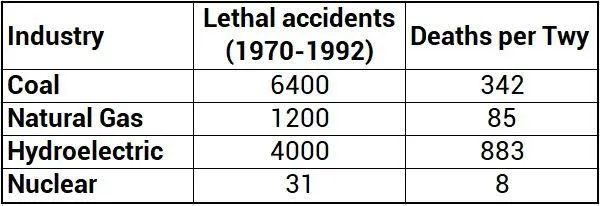
table showing the number of total fatalities, and the fatalities per TWy (TeraWatt year) within different industries. Data from The World Nuclear Associeation.
Conclusion
Nuclear energy can be seen as the 'aerospace industry' of the energy sector. Terrible accidents have made headlines in the last decades, but exactly because of that, the industry is one of the most secure and safest around.
Plants are also continuously inspected and redesigned to withstand current threads. Taking all of this into account I really don't understand why there are so many movements against nuclear energy. Is it the lack of a bigger picture? Bad image constructed over the years? When I see promising countries like Germany announcing a Nuclear power Phase-out I can only hope it gets replaced by better alternatives than their immense brown coal industry...
What is your opinion on this? Did I miss a certain point of view? let me know!

Sources
Schneider, M., Frogatt, A., Hazemann, J., Tadahiro, K., & Thomas, S. (2015). STATUS REPORT 2015 Mycle Schneider Antony Froggatt Julie Hazemann Tadahiro Katsuta Steve Thomas.
IAEA. (2018). Nuclear Energy Series Status and Trends in Spent Fuel and Radioactive Waste Management.
OECD/IEA. (2018). Global Energy & CO 2 Status Report, (March). Retrieved from http://www.iea.org/publications/freepublications/publication/GECO2017.pdf
Bou-Rabee, Firyal & Al-Zamel, Abdallah & Al-Fares, Rana & Bem, Henryk. (2009). Technologically enhanced naturally occurring radioactive materials in the oil industry (TENORM). A review. Nukleonika. 54. 3-9.
https://kleinmanenergy.upenn.edu/policy-digests/why-some-nations-choose-nuclear-power
https://www.worldnuclearreport.org/The-World-Nuclear-Industry-Status-Report-2015-HTML.html
http://www.world-nuclear.org/information-library.aspx
https://en.wikipedia.org/wiki/Generation_III_reactor
https://www.eia.gov/energyexplained/index.php?page=nuclear_environment
http://nuclearconnect.org/know-nuclear/talking-nuclear/top-10-myths-about-nuclear-energy
https://en.wikipedia.org/wiki/Enriched_uranium